
Learning, Healing, and Growth: Why Money Keeps Teaching Us the Same Lessons
Feb 13, 2026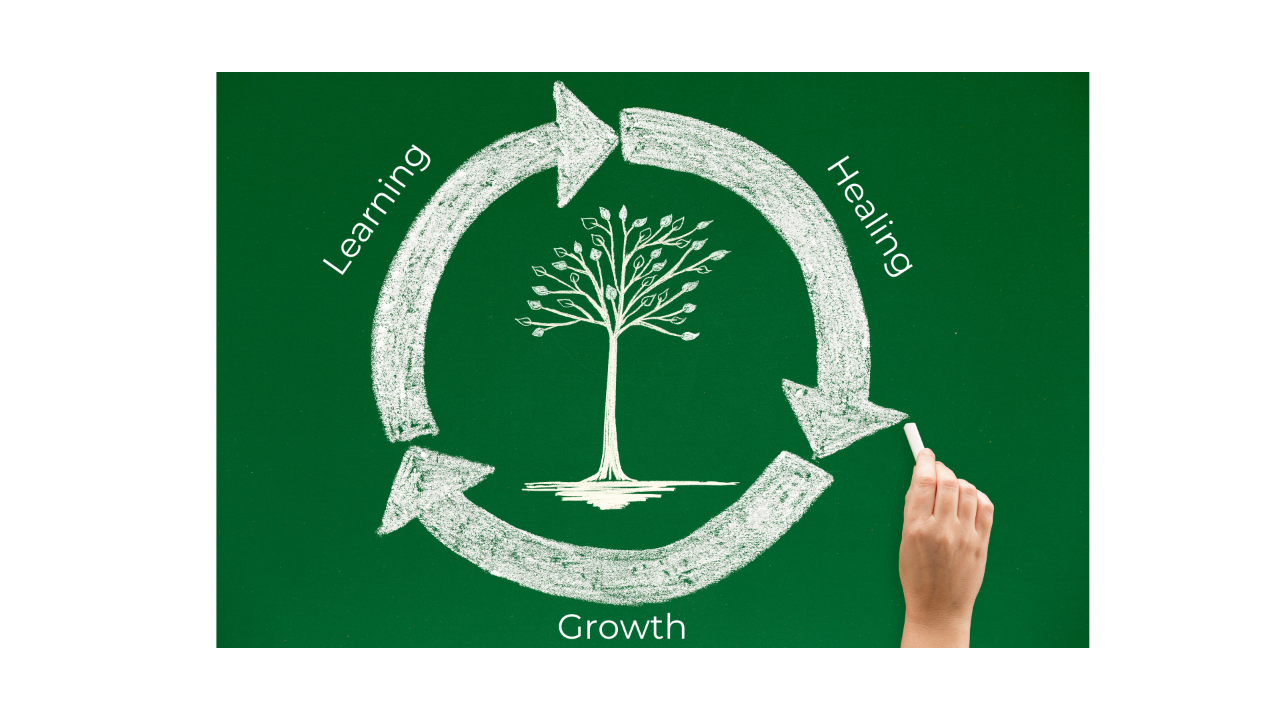
Most adults assume that learning, healing, and growth are separate processes.
-
Learning happens in classrooms or through reading.
-
Healing happens in therapy.
-
Growth is what we hope shows up later, if everything works.
But when it comes to money, those boundaries collapse.
Money activates our nervous systems, our attachment histories, our sense of identity, power, and belonging. That’s why financial conversations often feel bigger than the numbers suggest and why insight alone rarely leads to lasting change.
Across psychology, neuroscience, education, and contemplative traditions, a shared conclusion has quietly emerged:
We don’t grow by learning alone.
We grow through learning that heals and healing that teaches.
Money just happens to be one of the most emotionally charged classrooms adults ever enter.
Learning requires safety
Humanistic psychologist Carl Rogers was one of the first to name something many of us feel intuitively: meaningful learning only occurs when a person feels psychologically safe. When shame, fear, or judgment dominate, curiosity shuts down.
This insight has been echoed and deepened by neuroscientist and psychiatrist Dan Siegel, who shows that the brain learns best in states of integration, when emotional, relational, and cognitive systems are working together.
When money conversations trigger threat responses, fight, flight, freeze, or appease, the brain shifts into protection, not reflection. In that state, even excellent financial advice can’t land.
Healing restores the capacity to learn
Here is where many people misunderstand healing. Healing isn’t just about reducing symptoms or resolving past pain, it’s about restoring flexibility.
Trauma researcher Bessel van der Kolk has shown that unresolved trauma constrains neuroplasticity. In simple terms: when the nervous system is locked into survival mode, learning stalls.
Psychologist Diana Fosha takes this one step further. In her work, healing is explicitly framed as a transformational learning process. Emotional repair doesn’t just soothe, it reorganizes how a person understands themselves, others, and the world.
Growth is a reorganization of meaning
Adult development theory helps explain why money keeps resurfacing as a growth edge, especially for capable, high-functioning adults.
Developmental theorist Robert Kegan shows that growth happens when old ways of making meaning no longer work. These transitions are often emotionally destabilizing, not because something is wrong, but because the mind is being asked to reorganize itself.
Feminist psychologist and neuroscientist Lisa Feldman Barrett adds an important dimension here: emotions are not obstacles to thinking; they are how the brain learns to predict and adapt. Emotion and cognition are inseparable.
Growth, then, is not about emotional mastery or financial perfection. It’s about integration, the capacity to hold complexity, tolerate uncertainty, and respond with greater flexibility.
Learning as liberation and voice
Educational philosopher Paulo Freire framed learning as a process of liberation, of reclaiming voice, agency, and authorship over one’s life. While his work focused on social and political oppression, the parallel in money is striking.
Many people carry internalized narratives about money:
-
“I’m bad with money.”
-
“I shouldn’t want more.”
-
“Talking about money causes harm.”
Naming and questioning these stories is simultaneously educational and healing.
Similarly, financial planner and thought leader Gayle Coleman in her phenomenal book the body of money: a self-help guide to creating sustainable wealth through innate intelligence emphasizes that financial well-being must include the body.
The Financial Learning–Healing–Growth Cycle
In my work with couples and individuals, these ideas converge into a single, repeating pattern:
-
Safety opens learning
-
Learning exposes old wounds
-
Healing reorganizes meaning
-
Growth changes behavior
-
And money brings us back to the beginning again
This cycle isn’t a failure of discipline or intelligence.
It’s adulthood.
Money keeps returning us to this cycle because life keeps changing—careers, families, markets, health, inheritance, success, loss. Each transition invites new learning, often through discomfort.
A different way of working with money
At Healthy Love & Money, we don’t treat financial struggle as a technical failure or a moral flaw.
We see it as a developmental moment.
A moment where learning, healing, and growth are trying to happen at the same time.
When we slow down enough to honor that process, money becomes less of a battleground and more of a classroom.
In Reflection
If your financial life feels heavier than it “should,” it may not be a sign that you’re doing something wrong.
It may be a sign that you’re growing.

